Jay Toohey: The Decision He’ll Never Regret
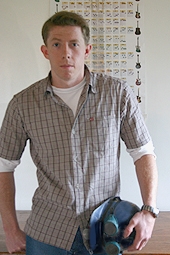
The best career decision Jay Toohey ever made—and probably the easiest—was actually made for him. The third-year apprentice boilermaker explains: “It was 2002 and I had been a welder for about two years. Then, all of a sudden, the B.C. economy took a downturn. And just as suddenly, there was no longer a great demand for welders.”
Jay says he knew he’d have to upgrade his skills if he wanted to take control of his own career. His first move? Look into the assistance programs being offered by the Government of Canada through the Human Resources Development Corporation.
“Best thing I ever did,” he says today. “It gave me the financial support I needed to move my career forward.” Jay’s first stop was the British Columbia Institute of Technology in Burnaby where his request was as simple as it was straightforward. “I told the instructor I wanted to enrol right now in the first metal trades class that was open. Turns out that was the boilermaker class. So I said, ‘great, let’s go for it.’”
The rest, as Jay might say, is history. And a pleasant history it’s been. “There’s really nothing I don’t like about the job,” he says. “I like working on the boilers, I like the friendship and support you get from the union and your fellow workers, I like the travel (Jay is 29 and single) and I like the idea that one day I might be able to pass on what I’ve learned to others.”
If he does go into teaching later in his career, Jay should have plenty to share with a new generation of boilermakers. Not only did he learn to work with his hands—and outdoors—while growing up in the country in Ontario, he helped his father build their house from the ground up.
“Just as important,” says Jay, “is what I’ve learned since I began work. For instance, thanks to my brother, who is also a boilermaker, I’ve learned how important it is to budget. Like a lot of jobs, there are periods of feast or famine so it’s important to set money aside when times are good.” Jay learned about the “feast or famine” nature of the industry early, working 10-hour shifts 52 of 53 days early in his career.
He never complained, though. Probably never will, either, he says today. “Yes, you get dirty, yes, you can work in some cramped conditions, and yes, you might have to travel some to get work. But the rewards are worth all of the effort.”