Amanda Gillcash: Her Career Choice Put a Roof Over Head
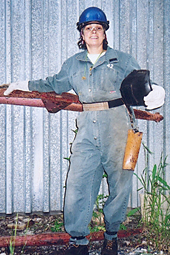
That was back in the 1970s, says Amanda. “I had just come from Ontario with a welding certificate and little else in my pocket. When I was told it would take a couple of weeks to upgrade my ticket, we had to find a place to live until I could start earning some money. That’s when we decided to tent it.”
For Amanda, the money she received for her first job did more than put four solid walls between her family and the outdoors—it confirmed that she could succeed as a boilermaker in what was then very much a male-dominated industry.
“Actually,” says the 52-year-old Amanda, “no one gave me a tough time when I started out as a welder and no one has given me any hassle since I became a boilermaker. In fact, early on, I probably worried more about it than the men I studied and worked with.”
Back in the 1970s, she certainly worried about it more than her welding instructor at Conestoga College in Stratford, Ontario. “I remember that our instructor was in his ‘60s or ‘70s,” she recalls, “sort of the age where you might expect a bit of bias to creep in. Instead, he told me to stop worrying about being a woman and think more about becoming an expert welder.”
That’s exactly what she did. “I’m not the most ambitious person in the world,” she admits, “but I have a strong work ethic and I’m drawn to the trade.” In fact, after trying arts school, taking some photo courses and working as a secretary, she was attracted to welding because it looked like so much fun. “All those kids with long hair, the noise, the dust and the energy—plus getting paid to go to school—that was pretty appealing.”
If she has one regret about her career, it’s a small one. “Maybe because everyone was always so positive to me throughout my career, I didn’t do as much to help other women feel comfortable in the trade. I know I got the career I hoped for. I just hope other women do, too.”